 Visit
Visit  Follow
Market Insight for June 13

Almost half (47 per cent) of first-time buyers who made a home purchase in the last 18 months were aged between 25 and 34, according to the Canada Mortgage and Housing Corporation’s (CMHC) 2025 mortgage consumer survey.
Where a buyer lives can also influence their age. In the Prairies, most new buyers fell within the 18 to 34 age range, while in regions like Atlantic Canada and British Columbia, first-time buyers tended to be slightly older, CMHC noted.
Leah Zlatkin, mortgage broker and chief operations officer at Mortgage Outlet Inc. in Concord, Ont., says that in the Greater Toronto Area, first-time buyers are typically older than their counterparts in the Greater Horseshoe Area or the Prairie provinces.
“Many of the buyers I work with are in their late twenties to mid-thirties,” Zlatkin said. “Though from time to time, I do assist younger clients—often with help from their parents.”
She attributes this trend to the higher housing costs in the GTA. “People generally need more time to save, especially if they’re aiming for a larger home that suits a growing family,” she added.
Although the 25–34 age group has consistently led since 2019—reaching a high of 56 per cent in both 2023 and 2024—it dropped modestly in 2025, per CMHC findings. The demographic is shifting upward: buyers over 35 made up 39 per cent of the market in 2025, up from 33 per cent in 2024 and 30 per cent the year before.
According to Statistics Canada, the median age of those claiming the first-time home buyer tax credit was 32 in 2022—the most recent year available—up from 30 ten years earlier.
Still, some Canadian cities are managing to attract younger buyers, particularly where housing prices are more accessible.
Montreal offers the best value across Canada where a lot of young people are moving here from other provinces, since they can buy a condo for $500 per square foot instead of $1,000 like in Toronto.
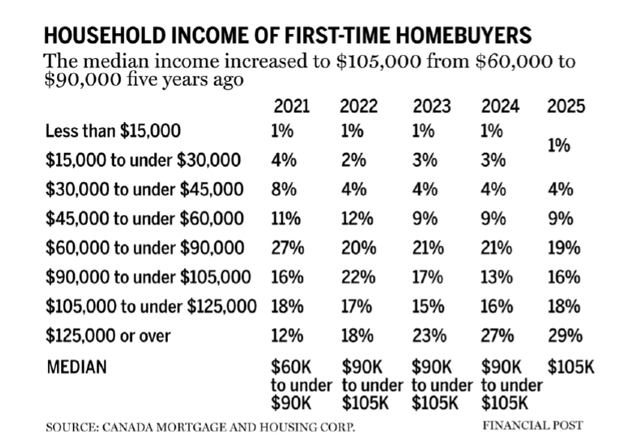
How much income does a first-time homebuyer need?
The income levels of first-time homebuyers have risen in recent years, crossing into six-figure territory: CMHC reports that in 2025, the median income was around $105,000 — a jump from the $60,000 to $90,000 range noted five years prior.
As per the Canadian Real Estate Association (CREA), the national average home price stood at $707,380 in April. In Ontario and British Columbia, averages neared $1 million, while in Atlantic Canada and in provinces like Saskatchewan and Manitoba, prices ranged between $300,000 and $400,000.
CMHC also found that 71 per cent of first-time homebuyers were married or in common-law relationships, and 91 per cent had jobs.
More than half of these buyers had children in their households, and 64 per cent were renters prior to buying, with an average renting period of 6.3 years.
A growing number of single women in their thirties or early forties are entering the housing market, often purchasing solo — a sign of increasing financial independence and less emphasis on waiting for a partner.
CMHC’s findings also show that 54 per cent of first-time buyers bought a home with another adult who was not their spouse or partner. This trend was most prominent among younger adults aged 18 to 24 and was especially common in Quebec.
How are first-time buyers putting together their down payment?
According to CMHC, key sources for down payments included 39 per cent from non-RRSP savings, and 38 per cent from first home savings accounts (FHSAs).
But the most common contribution came in the form of gifts: more than 40 per cent of first-time buyers received financial gifts to assist with their purchase, with the typical gift totaling $74,570.
Gift reliance varied by region — those in higher-cost provinces like Ontario and B.C. were more apt to receive such support, while those in the Prairies were more reliant on their own savings.
Gift amounts ranged widely — from $43,086 in the Prairie provinces to as high as $142,812 in British Columbia. As real estate values outpace wages, parents are increasingly stepping in to close the gap.
CMHC also highlighted a notable jump in the number of buyers who lived with family or friends before purchasing — 35 per cent in the current year, compared to 28 per cent the year before. It’s likely this choice reflects efforts to cut expenses and boost savings in preparation for a home purchase.
Parental help also influences the timeline to save for a down payment. CMHC reports that first-time buyers typically saved for 3.7 years — but without family assistance, it often takes five to seven years, especially in expensive markets like Vancouver.