 Visit
Visit  Follow
Market Insight for February 27

The Greater Toronto Area (GTA) is experiencing a noticeable increase in “Power of Sale” listings as of late 2025 and moving into early 2026. While still representing a small fraction of the total market, these distressed sales, where lenders take possession and sell properties after borrower’s default, have become a more frequent sight due to high interest rates, the “renewal cliff,” and declining home values.
Key Trends in GTA Power of Sale – Early 2026
Surge in Activity: Power of sale listings have risen significantly. For example, in 2025, downtown Toronto saw more than four times the number of Power of sale listings compared to 2023. By early 2026, some reports indicated that over 1.1% of active listings in the GTA were under Power of sale or mentioned “mortgage” in the line where the seller’s name would be.
Hotspots: Brampton currently holds one of the highest concentrations of Power of Sale listings in the GTA, driven by a high volume of private lending and variable-rate products. Other areas experiencing high distress include Ajax, Brock, Oshawa, and Stouffville.
“Renewal Cliff” Impact: Many of the cases trace back to risk-taking in the ultra-low-rate period from 2020 to mid-2022 and are now facing renewals at much higher interest rates (4% or higher), resulting in “carrying cost shock” and forcing sales.
When a homeowner can no longer pay the mortgage, the lender can take ownership of the property and sell it.
In Ontario, a Power of Sale is a lender’s legal remedy to sell a property after mortgage default (usually 15+ days) without taking title, typically completed in 3-4 months. The lender sends a Notice of Sale, triggering a 35-day redemption period for the borrower to pay arrears/fees, followed by eviction via a Writ of Possession to evict the occupants.
According to CMHC, mortgage delinquency rates have climbed from 0.13 per cent in the first quarter of 2020 to 0.24 per cent in the third quarter of 2025 and are expected to climb further in the year ahead.
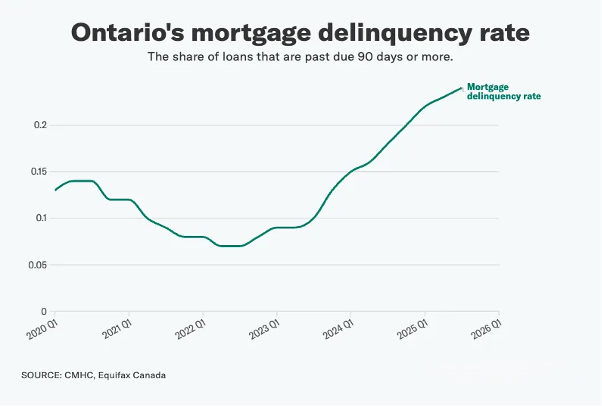
There are probably lots of sellers that are trying to sell their properties right now that are in a somewhat desperate situation and they’re a month away from power of sale, but you’d never know that because they’re not going to disclose that in the property listing.
While power-of-sale listings still make up only a small share of the market, some experts say their impact can trickle down through the housing market.
Lenders will sometimes accept lowball offers on these properties, which can affect neighbouring home sales. The way real estate works is that the most recent sale of a similar home is then used as a comparison for other properties when they go up for sale.
However, lenders do have a fiduciary duty to sell at fair-market value and typically hire a realtor to manage the process. Properties could still sell for less, but lenders need to show they acted reasonably. That said, they’re not expected to hold the home for an extended period.
The value of power-of-sale properties can sometimes be lower because they are not always well-maintained by the time they hit the market. If a homeowner is struggling to pay their mortgage, it’s unlikely they’re doing timely renovations.
Buyers also take on additional risk because homes are sold in “as is” condition, meaning there is limited recourse if issues arise after closing. For example, if on closing day the stove no longer works, they don’t have the same recourse as they would with a typical transaction.
It’s difficult to point solely to Power-of-sale listings as the reason neighbourhood prices are slipping, since values are softening across the board. That said, these properties are increasing in inventory in an already sluggish market, and the excess supply relative to demand might be adding downward pressure on prices.