 Visit
Visit  Follow
Market Insight for November 14

The average monthly rent for a unit in Canada’s largest city slipped 3.5 per cent in October compared to a year earlier, landing at $2,551, according to the latest National Rent Report from Rentals.ca and Urbanation.
Despite Toronto remaining among the priciest cities in the country — behind Vancouver and Oakville — rents declined at a faster pace than the national average, which was down 2.2 per cent to $2,105.
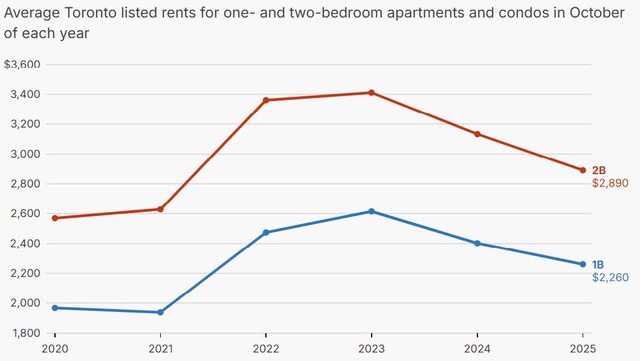
Two-bedroom apartments in Toronto saw the sharpest drop among major Canadian cities, falling more than seven per cent year over year to $2,890. One-bedroom units dipped 5.7 per cent to $2,210, while three-bedrooms were down 4.6 per cent to $3,492.
How Toronto Rents Have Been Falling
“The figure for two-bedroom units lines up closely with other big cities like Calgary and Vancouver,” says Rentals.ca spokesperson Giacomo Ladas.
Ladas notes that during the pandemic, demand for two-bedroom units rose as more people worked remotely and required home offices. Now, with demand cooling and supply rising, rents for vacant units are trending downward — a pattern he expects to continue into 2026.
“The federal government stepped in and removed HST for developers who wanted to build purpose-built rental,” says Ladas, adding that condos that aren’t selling are now being rented. As inventory grows, landlords have to adjust pricing to stay competitive.”
With prices softening, Ladas says Toronto remains firmly in a “renter’s market,” a trend likely to last through the slower winter months when fewer people move.
“If there’s ever a good time to negotiate, it’s now,” he adds, noting that property managers are increasingly offering incentives — like one-or-two months’ free rent, complimentary utilities, or free internet — to attract tenants.
Rents declined across Toronto’s boroughs, with East York showing one of the steepest annual drops in the country at 13.5 per cent.
Across Ontario, average rents fell 2.2 per cent year over year to $2,299, with price declines across studios, one-bedrooms, and two-bedrooms, while three-bedroom rents edged up about one per cent.
Ontario remains among the most expensive provinces, second only to B.C., with 12 of the top 20 priciest cities for average asking rents — including Oakville, Toronto, North York, Etobicoke, Mississauga, and Kingston, all in the top 10.
Even as more employers push return-to-office mandates, potentially boosting demand for homes closer to downtown cores, Ladas says there’s no clear shift yet.
“I think people right now are just prioritizing affordability much more than accessibility,” he says. “If they have to take an extra half-hour commute, they’ll do it to save rent.”